Lifelong Education and Erasmus+
The promotion of lifelong learning is a cornerstone of EU education policy, in part to address skills shortages and to raise education levels across European societies. Lifelong education does indeed, as the EU’s Erasmus+ tagline suggests, “enrich lives and open minds.” Thousands of innovative adult education initiatives exist within the Erasmus+ spectrum and in every European nation. National governments, both individually and collectively, promote lifelong education through funding and information campaigns.
Well-being among citizens and thriving economies emerge from quality education, not just for children but also for adults. For its part, the business community continually seeks skilled employees, making professional development and basic skills training an everlasting necessity.
This blog post examines lifelong education, relevant trends and statistics, barriers to learning, and the role the Erasmus+ project plays in its promotion.

What Is Lifelong Education and Why Does It Matter?
Let’s start by making the distinction between lifelong learning and adult learning:
Lifelong learning encompasses all learning you engage in throughout life to enhance your knowledge, skills, and competencies. The learning context can be personal, civic, social, or job-related.
Adult learning refers to your participation in lifelong learning, typically educational activities you participate in after finishing conventional schooling, such as primary, secondary, and tertiary education.
When discussing lifelong education, the spotlight falls on educators and their role in delivering learning to people across various ability groups and age groups. UNESCO highlights the imperative to make education universally accessible:
- To all age groups
- At all education levels
- Using all modalities: formal, informal, self-paced, community, etc.
- Inside all learning spaces: schools, museums, libraries, community facilities, workplaces, homes, etc.
- Accessible to all regardless of social, cultural, or economic background
The push to establish solid adult education structures in all member states seeks to address personal, social, and economic needs against a backdrop of ageing populations.
Adult Education in the EU – Statistics and Trends
The EU adult education target, whereby by the end of 2025, 47 per cent of the adult population will participate in continuing learning, was already reached in 2022. Reaching this milestone places the bloc on track to meet its 2030 participation numbers. Although at first glance positive, a deeper look reveals significant disparities among the member states. Whereas in Sweden, over 70 per cent enrolled in formal or informal training, less than 20 per cent did so in Bulgaria and Greece.
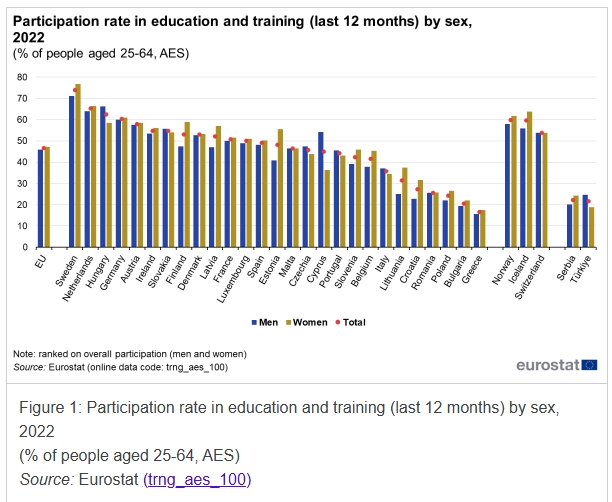
The end-of-year 2030 target aims to increase participation to 64 per cent among 25-64 year-olds, easily achievable in some countries, far beyond reach in others.
It is vital to recognise that not all adult learning is equal. To begin with, some training may be informal, and secondly, it may not address the skills shortages existing across the EU, as the OECD’s 2023 report on adult learning states:
Much of today’s adult training is compliance- or safety-driven and of quite short duration; this may be insufficient to meet the upskilling and reskilling needs of fast-changing labour markets.
To increase participation across nations, age, social, and cultural groups, barriers to learning must be uncovered and eliminated.
Barriers to Learning
Iranian Social and Behavioural Scientist, Marjan Laal, University of Tehran, published a paper on barriers to learning in 2011. During her research, she sought to establish the reasons why people are either hesitant or unwilling to participate. Like other learning experts before her, she concluded that factors preventing individuals from continuing education are multifaceted.
During the course of her work, she identified the following learning barrier categories:
- Personal: An individual may lack the confidence or self-esteem to enrol in a course.
- Financial: Lack of funds excludes people from participation in areas where free adult education is not available.
- Structural or societal: Training may not exist or be physically accessible to an individual.
- Unsuitable course offers: Programmes available in an area may not align with the skills, prior knowledge, or interests of an individual.
Every adult has a different starting point, meaning each person must overcome a specific set of obstacles, some insignificant, others considerable.
Including Hesitant Learners
Much research and work have gone into attracting hesitant learning back into education on an EU level. Lifelong education experts published roadmaps for public and private course providers.
The EU set up Outreach, Empowerment and Diversity (OED to support and advise educational institutions in their work in lifelong education.
In 2014, the European Association for Adult Education (EAEA) delivered a manual on how to attract hesitant learners back into education.
Reaching out to adults within their environment through adults who’ve successfully continued their education is just one of the many methods put forward in the manual. Overcoming the above-mentioned barriers through outreach, funding, and differentiated course offerings is the first and most important step.
Course providers must enjoy the full backing, financial and structural, of local and national governments and recognise the cross-societal benefits of adult learning. Education policymakers must make adult education a priority.
Lifelong Education with Erasmus+
With its Erasmus+ programme, the EU supports and promotes adult education, giving access and financial support to various groups.
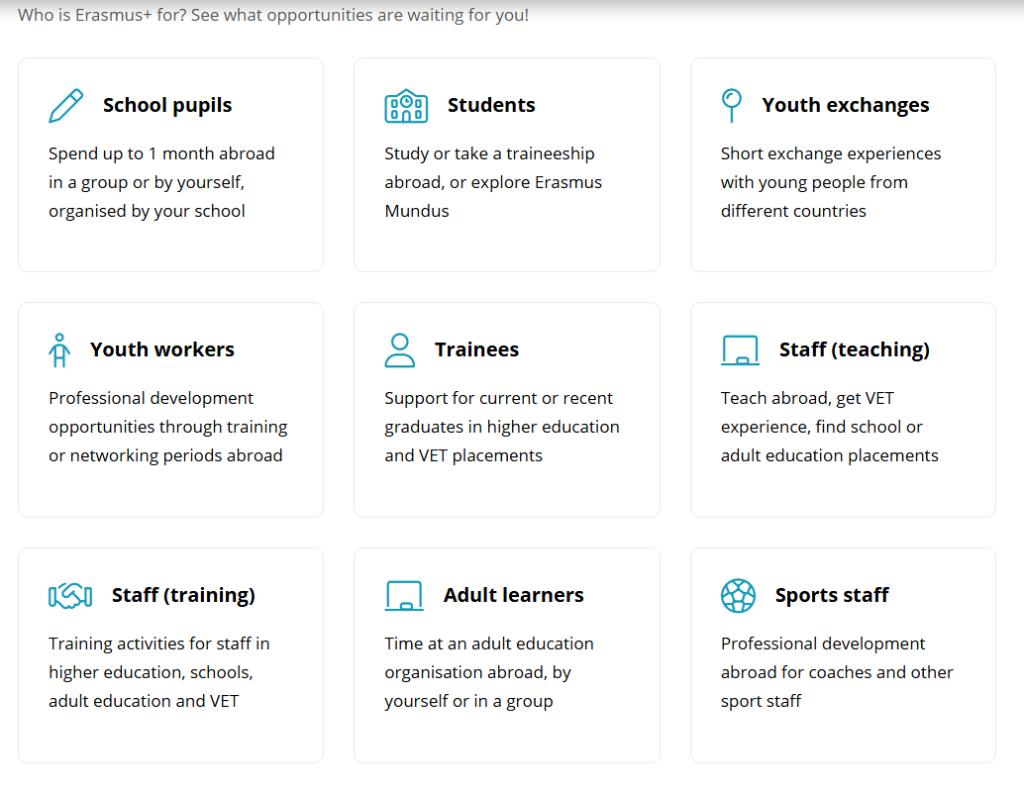
Although in most instances it is not possible for individuals to apply directly, accessing Erasmus+ training opportunities and funding is relatively straightforward. Most European educational institutions have a nominated Erasmus+ coordinator ready to assist with the application process.
Lifelong learning opportunities and benefits come alive for thousands of people across the bloc through an abundance of innovative adult learning and professional development programmes.
An Abundance of European Adult Learning Projects
Anyone considering participation will soon discover an outstanding selection of courses in a wide range of subject areas and stunning locations. You can learn “Joyful English” in Italy, dive into “English Language and Irish Culture” here in Galway or venture to La Réunion to explore “Diversity in the Classroom.”
The benefits ripple beyond professional or educational spaces into communities and societies across Europe. For the individual, learning can’t but bear rich fruit.