

Explaining Complex Concepts in English – Language Lab
Explaining complex concepts in a language that isn’t your mother tongue is challenging, even for the brightest minds. Regardless of the setting, be it education or business, rising to the task requires considerable forethought and preparation. Not only will you have to find ways of presenting complicated ideas in an understandable fashion, but you will have to identify and use the right words and register in English.
We have dedicated this month’s Language Lab to providing you with a roadmap to presenting perplexing ideas clearly and concisely.
Get Comfortable First
Before you consider your audience or set out to prepare, you must get accustomed to speaking or writing about your topic in English. If you already work in an international environment, you may already feel at ease discussing your expertise in English. The bottom line is that you must be able to cover the basics of your topic in English without breaking out into a sweat.
Gather the correct terminology and practice speaking on your subject alone or within earshot of family and friends. Ask them to roleplay with you until you are 100% comfortable giving a general overview. You can subsequently move on to preparing to introduce more depth.
Throughout this pre-preparation phase, immerse yourself in relevant content; listen to podcasts, read papers, and watch presentations on YouTube. Doing so will allow you to hit the right tone and register when it is your time.
In Your Audience’s Shoes
Next, you must define your audience and assess their prior knowledge to identify a foundation. If, for argument’s sake, you need to explain algorithms to IT students, you will have a diametrically opposed starting point from introducing this concept to a group of culinary experts.
Once you have established the parameters, you can determine the starting point and define the depth you will seek out.
A Step-by-Step Guide to Explaining Anything to Anyone
The following steps help you present and explain any topic:
- Present the Topic and Provide Reasons for Introducing it: “Today, I’d like to explain the concept of…….
- Give a Simple Definition: “In simple terms, …… is like a ……. that …………….” Example: “In simple terms, a blockchain is like a digital ledger people share across a network of computers.”
- Explain the Core Points or Steps: “The process involves two key elements: A and B. A is responsible for…, while B handles…” Or: “There are three main parts to this concept: first…, second…, and finally…”
- Summarise, Restate the Core Idea and Purpose: “To recap, the main takeaway is that [cloud computing] facilitates data storage remotely instead of on our own computers.”
Your Language Toolkit
Each step will see different phrases that allow you to create a logical, free-flowing sequence, ready to be understood and absorbed by your audience.
Structuring Phrases
- “Let’s examine…….
- “Firstly,……..
- “Moving on from this idea,…….
- “Another point to consider is………
Clarifying Phrases
- “In simple terms, ……
- “To put it simply……..
- “Think of it this way…….(make an analogy)
- “In other words…..(rephrase and restate)
Checking-In Phrases
- “Does this make sense so far?”
- “Would you like some more examples?”
- “Do you follow?”
- “Do you have any questions?”
Analogies Work Wonders
No tool is quite as powerful as a good analogy. Find one for your complex concept, and your audience is halfway to grasping it. Here are some examples:
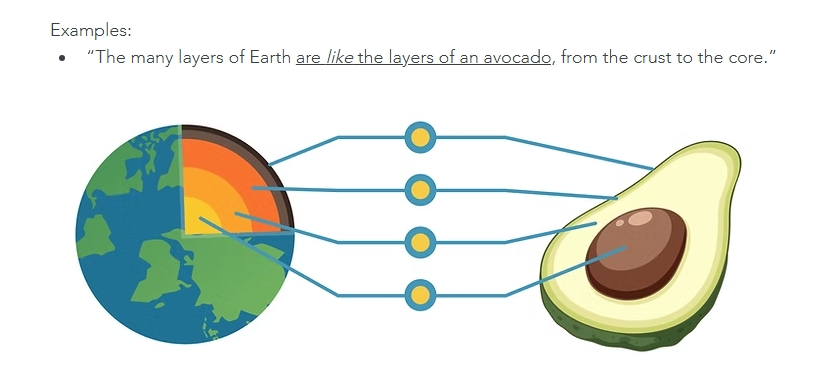
Analogies serve to simplify complex concepts, foster understanding, and captivate learners. Far from new, analogies have been the go-to tool for some of history’s greats:
- Newton likened the universe to a giant clock with a sophisticated mechanism and overlapping gears – all subject to the laws of physics.
- Francis Crick and James Watson explained DNA by comparing it to a twisted ladder.
- Richard Feynman used the analogy of rubber bands to introduce electromagnetic fields. He was renowned for using analogy not simply to liken something but to illustrate how something works and moves.
Slow and Steady Wins the Race
Despite intense preparation, you will likely find explaining complex ideas challenging initially. Remember to take a few deep breaths and maintain a slow but steady pace.
Here are a few phrases you can use should you ever get stuck:
- “Please bear with me, as I work this out.”
- “Let me try to say that in a different way.”
- “Apologies, I can’t remember the technical term. It’s the process of…”
- “This is a bit complex, so let me break it down into manageable chunks.”
- “I think I confused the terms. It’s actually…..”
These phrases buy you time and give you the chance to gather your thoughts and continue. Taking the time and space to get back on track will make you appear calm and confident, so it’s always a win-win.